
REVOPOINT / Applications & case studies
A scanner gallery becomes more useful when the examples are read as different jobs rather than a single performance claim. A complete body, an engine housing, a clay figure and a coin may all become digital geometry, but each puts attention on a different part of the capture.
This selection brings together four galleries supplied by Revopoint for the original Trackit. It includes both supplier demonstrations and attributed community work. These examples concern Trackit's optical-tracking workflow; they should not be relabelled as Trackit SR projects.
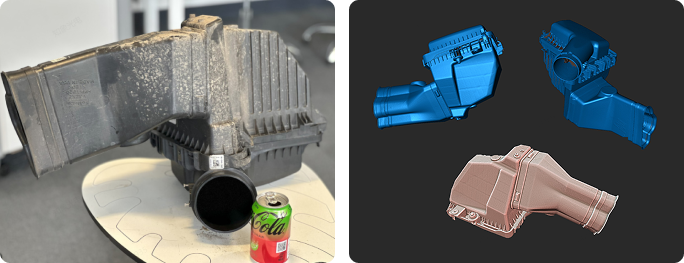
Cover: Rilot's 2021 Mustang air-filter housing combines tracked captures into a component reference. Image supplied by Revopoint.
Large subjects: aircraft, container and vehicle body
One gallery features a Europa XS aircraft and a steel container. Another shows a BMW 3 Series E46 body, with the supplier listing dimensions of 4,480 by 1,740 by 1,369 mm. Together, they establish that these published examples go beyond objects that fit on a small bench.
The examples do not describe every capture position or the way each session was divided. They therefore offer a visual reference for the subjects, not a complete setup guide. Nor does an aircraft appearing in a gallery establish an airworthiness inspection: the confirmed outcome here is a scan demonstration, without a documented engineering acceptance process.
The vehicle-body example is also distinct from a case where a new body kit has been designed and manufactured. Capturing the existing car can support later work, but the gallery itself should not be used to invent a completed redesign or a measured production saving.
Assemblies: bellhousing, gearbox and engine

The automotive selection includes a Mustang bellhousing, a gearbox and engine scans. These move the focus from an overall vehicle outline to the form of individual housings and assemblies, where openings, transitions and surrounding features become the visible subject.
A separate dyno-shaft example brings in a more compact mechanical form. Read together, these are useful illustrations of the variety of automotive geometry presented in the source material. They are not a published comparison against drawings, and no acceptance tolerance or certified measurement report accompanies this selection.
Dark components: intercooler piping and airbox
Jermaul W shared a black plastic intercooler pipe, placed upright on a table and captured by moving around it. He reported obtaining the details he needed from one scan. That account describes the arrangement of this particular object rather than a universal promise about dark plastic.
Rilot's 2021 Ford Mustang air-filter housing took a different route: three tracked captures were merged, using the black-object mode. Keeping these two examples separate is helpful. One creator achieved the intended result in a single capture; another combined several views. The number of scans is a project choice, not a result that should be transferred unchanged to every component.
From a vehicle pillar to a small coin
Jan Proschenski's Passat B4 example records an A-pillar and carries the result through to a print on an H2D. The source establishes that scan-to-print connection without describing the printed piece as an approved structural replacement for the vehicle.
At a different scale, the supplier's 5-franc coin example is listed at 30 mm across and 3 mm thick. A tyre appears in the same gallery, adding another rounded form with a different surface character. These objects help readers compare the kinds of geometry being shown while avoiding a claim that size alone determines the appropriate capture method.
Art objects broaden the purpose of capture

Rilot also shared a handmade clay statue captured in tracked mode. Another source gallery includes an antique painting and frame. These subjects place shape recording in an art context, rather than assuming every scan is intended to become an engineering replacement.
The range is the useful point of the combined showcase. Original Trackit appears around large structures, compact components and creative objects, with different capture and processing choices reported where the sources provide them. The resulting geometry remains a starting point for whatever design, documentation or analysis task follows. Looking at the intended use of each result is more informative than treating the whole collection as one identical scanning exercise.
Build your REVOPOINT workflow with Creality AU
View REVOPOINT Trackit for the original model represented here. Use the galleries to identify relevant object types, then define the data and verification your own downstream task will need.
View products and package optionsImages supplied by Revopoint and reproduced with permission. Supplier and community examples are not independent tests by Creality AU. Back to Guides & News